In the 2010s, many retailers believed that implementing an ERP system would solve their inventory challenges.
That was the dominant thinking:
“Get the system right, and everything else will follow.”
So businesses invested heavily in dashboards, reports, workflows, and data capture systems. Information became more organized. Visibility improved. Transactions became easier to track.
And then they waited for transformation to happen.
But for many retailers, the expected breakthrough never came.
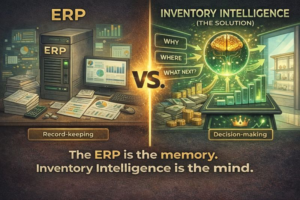
Because ERP systems don’t think.
They record.
They are excellent at storing historical information—what sold, where it sold, and when it moved. But they cannot explain why a product performed, what demand is likely to look like next, or what action should be taken proactively.
That is where the real shift begins.
Inventory performance changes when logic is layered on top of data. When systems move beyond reporting and begin guiding decisions. When inventory management evolves from hindsight into foresight.
At that point, inventory stops being a record-keeping exercise and becomes a strategic decision-making advantage.
The distinction is simple:
ERP is the memory.
Inventory intelligence is the mind.