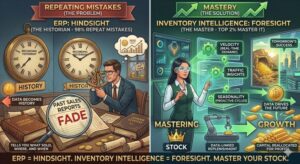
A common belief among retailers is that their ERP system is optimizing inventory. In reality, it isn’t.
ERP systems are designed to record and organize what has already happened. They provide visibility into sales, stock movements, and historical performance. In that sense, they are excellent historians—accurate, structured, and reliable.
But they are not decision-makers.
They cannot determine what should sell next, how much inventory to buy, or when to stop replenishing a particular SKU. As a result, many retailers continue to rely on reports to guide buying decisions, often repeating the same patterns that led to inefficiencies in the first place.
This creates a cycle where decisions are based on hindsight rather than real-time demand signals.
The most effective retailers operate differently. They layer inventory intelligence on top of their ERP systems—using logic that interprets product velocity, store traffic, and seasonality to guide forward-looking decisions.
Instead of reacting to what has already happened, they anticipate what is likely to happen next.
The distinction is simple but powerful.
ERP provides hindsight.
Inventory intelligence provides foresight.
And that difference defines whether you are managing stock—or truly mastering it.