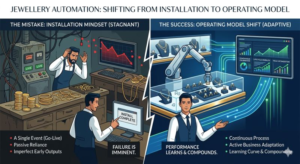
One of the most expensive mistakes in jewellery retail automation is treating it like a software installation instead of an operating model transformation.
Many projects begin with the assumption:
“Once the system goes live, it will run on its own.”
But optimisation does not work that way.
True inventory automation requires far more than implementation. It demands continuous calibration, lifecycle-based thinking, and patience during the learning phase.
The strongest retailers understand that inventory decisions are dynamic. Demand shifts. Store behaviour evolves. Product lifecycles change. And optimisation models need time, feedback, and refinement to align with real-world conditions.
This is why early-stage outputs should not be treated as proof of failure.
When depth recommendations feel unfamiliar or replenishment patterns appear imperfect in the first few cycles, the system is not necessarily broken—it is learning.
And that learning compounds over time.
The retailers who succeed with automation are not the ones who expect perfection immediately. They are the ones who adapt their operating rhythm to support the system’s evolution.
Because automation is not a plug-and-play tool.
It is a long-term shift in how decisions are made, refined, and scaled across the business.