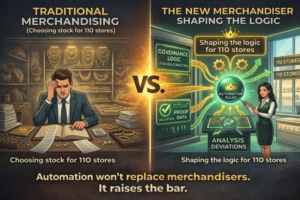
Automation will not replace jewellery merchandisers. But it will replace the version of merchandising that refuses to evolve.
As retail networks expand, the complexity of managing inventory across dozens—or even hundreds—of stores increases exponentially. The traditional approach of manually selecting stock for each location is no longer scalable.
The real shift is not about removing the expert—it is about redefining their role.
The value of a merchandiser is no longer in choosing individual SKUs for every store. It lies in shaping the logic that determines how those decisions are made at scale.
High-performing merchandisers are already making this transition. They validate system recommendations with data-backed reasoning. They focus on analyzing deviations rather than reviewing static dashboards. And most importantly, they influence the rules and decision frameworks instead of managing line-by-line selections.
Automation does not reduce the importance of the role—it elevates it.
It demands stronger thinking, clearer governance, and a deeper understanding of how decisions are made.
In this new environment, governance is not a supporting function.
It is the competitive edge.
Retailers who recognize this will not just adapt to automation—they will lead with it.