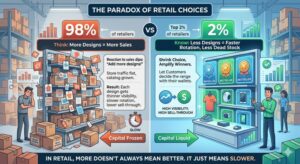
A majority of retailers operate under a common assumption—more designs will lead to more sales. In reality, the opposite is often true.
Adding more options does not increase demand. It simply spreads existing demand thinner across a larger catalogue.
When sales slow down, the instinctive response is to introduce more designs in the hope of attracting customers. But in most cases, store traffic remains unchanged—only the number of SKUs increases.
As a result, each product gets less visibility, slower rotation, and reduced sell-through. High-performing designs lose prominence, while new additions struggle to gain traction. Over time, capital becomes tied up in inventory that feels “new” but behaves like dead stock.
The problem is not a lack of variety—it is a lack of focus.
Leading retailers approach this differently. Instead of expanding endlessly, they refine their assortment. They reduce unnecessary choice, amplify their best-performing products, and let actual customer demand shape their range.
Because in retail, more does not always mean better.
Often, it simply means slower movement, lower efficiency, and weaker returns.
The goal is not to offer everything.
It is to offer what works—and let it scale.