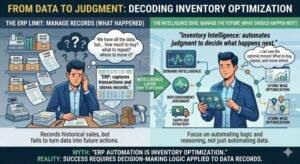
Inventory optimization is often overcomplicated. Many retailers believe that implementing the right ERP system will automatically solve their inventory challenges.
But that’s a misconception.
ERP systems are designed to record what has already happened. They capture transactions—sales, stock movements, and adjustments—with accuracy and consistency. However, they are not built to decide what should happen next.
They cannot tell you how much to buy, what to repeat, or where inventory should be moved to maximize performance. As a result, many retailers continue feeding more and more data into these systems, expecting insights to emerge. But data alone does not create decisions.
True inventory optimization begins when logic is layered on top of data. It requires systems that interpret patterns, connect demand signals with supply decisions, and guide actions across stores and categories.
The most effective retailers understand this distinction. They don’t just automate data capture—they automate judgment. They convert information into intelligent, forward-looking decisions that improve availability, reduce excess, and enhance overall efficiency.
ERP systems manage your records.
Inventory intelligence manages your future.