Focus on execution.
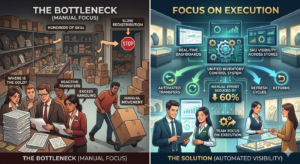
As retail businesses expand, store networks become significantly more complex. Hundreds of SKUs spread across dozens of outlets create operational challenges, especially when visibility across locations is limited.
In many cases, inventory decisions are still driven by manual stock movements and reactive transfers. This leads to frequent bottlenecks, unnecessary handling, and slow redistribution of products across stores. The result is inefficiency at scale—teams spend more time managing inventory than actually driving sales and execution.
The challenge is not just about managing inventory, but about managing it efficiently across a distributed network.
A unified inventory control system can transform this. By automating transfers, refresh cycles, and returns, it ensures that stock flows seamlessly across locations without constant manual intervention. This reduces operational friction and enables faster, more accurate decision-making.
In fact, such systems can reduce manual effort by up to 60%, freeing teams to focus on what truly matters—execution, customer experience, and growth.
In a complex retail environment, operational efficiency is no longer optional. It is the foundation of scalable execution.